Romanticism, Fantasy, and the Landscape: The Roots of My Visual Language

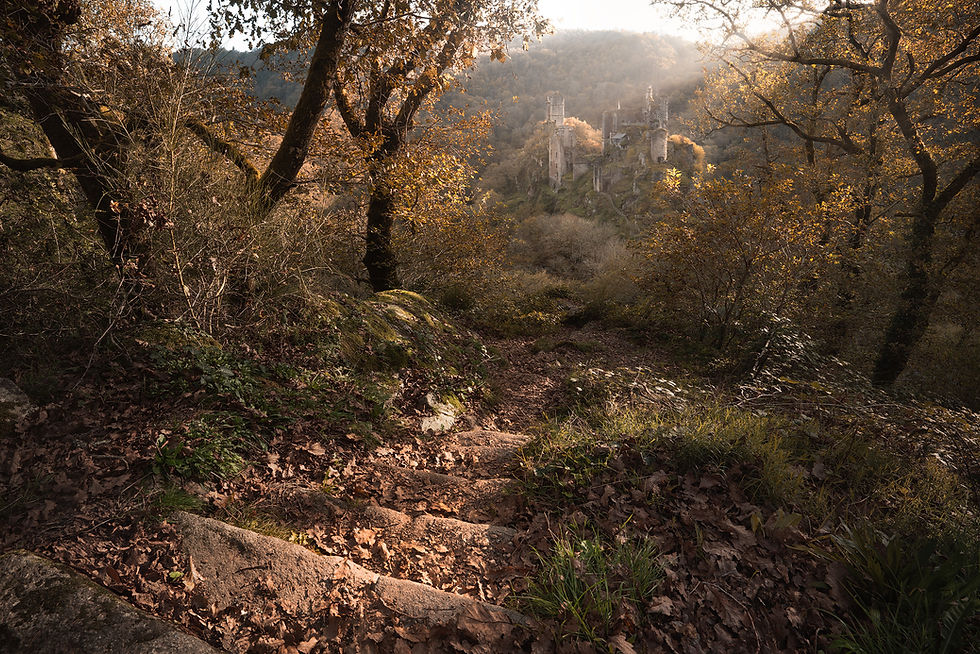
My work does not originate from an attraction to places, nor from a desire to describe them. It originates from a deliberate distance taken from the contemporary visual environment, where images are consumed rapidly, stripped of depth, and reduced to interchangeable motifs.
What I construct through photography is not a response to visibility, nor an attempt to participate in the continuous circulation of familiar scenes. It is an effort to suspend the viewer inside a visual space that resists immediacy, recognition, and repetition.
Romanticism, fantasy, and cinematic language are not aesthetic references layered onto my images.They define the structure through which reality is filtered, slowed down, and reassembled into something autonomous.
The Landscape as an Inner and Symbolic Space
Romantic painting established a decisive rupture with the descriptive function of landscape.Nature was no longer a subject to be cataloged, but a symbolic territory through which existential states could be articulated.
In the work of Caspar David Friedrich, the landscape is constructed as a threshold.Fog interrupts clarity. Ruins displace time. Scale diminishes the human presence until it becomes uncertain, almost provisional.
These images were never intended to reassure.They were designed to create distance, silence, and confrontation.
This principle is fundamental to my own practice.I am not interested in visual comfort.I am interested in images that slow perception, that withhold immediate meaning, and that invite contemplation rather than recognition.
Myth, Construction, and the Refusal of the Obvious
The painters of the Hudson River School further radicalized this approach by transforming real landscapes into constructed visions.Their work was grounded in observation, yet liberated from factual fidelity.
Artists such as Albert Bierstadt shaped the natural world into an idealized and often unreachable space.Light was orchestrated, scale was amplified, and geography was subordinated to narrative intent.
What emerges from this tradition is not a style, but a position:reality is material, not authority.
This position informs my choice of subjects.I deliberately avoid scenes that function as visual shorthand within contemporary photography.Iconic viewpoints, instantly recognizable landmarks, and compositions designed to perform well within algorithmic systems do not interest me.
My images are built to dislocate the viewer from the familiar and to interrupt the endless repetition of clichés that dominate social media feeds.
Against the Logic of Instant Recognition
The contemporary visual ecosystem rewards speed, clarity, and immediate legibility.Images are expected to declare their subject instantly, to confirm expectations, and to dissolve just as quickly.
My work moves in the opposite direction.
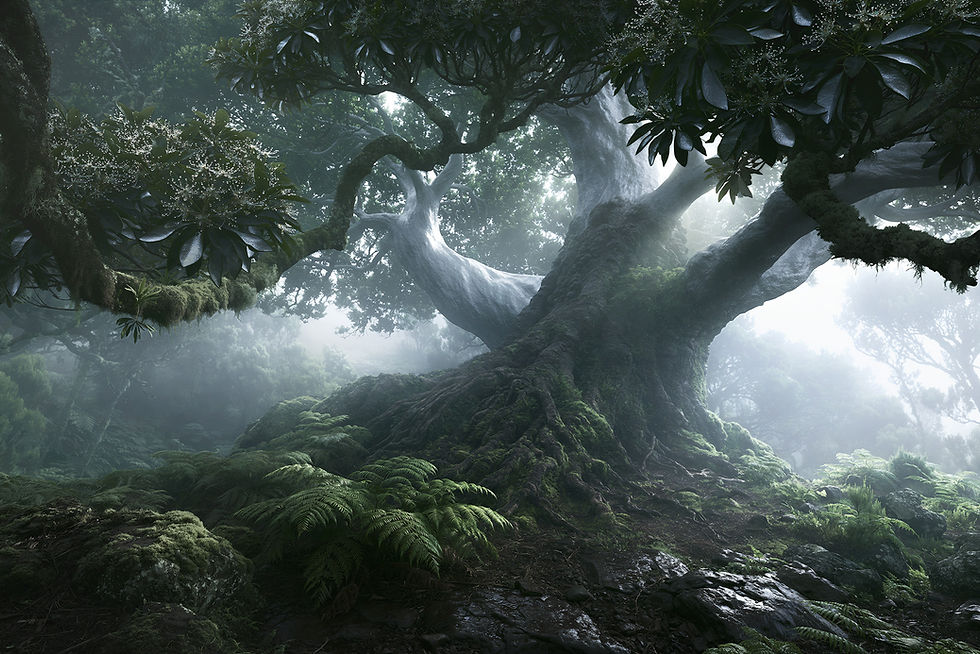
The choice of subjects, atmospheres, and compositional structures is intentionally anti-performative.Forests without landmarks. Ruins without names. Landscapes suspended outside of seasonal or geographic certainty.
This removal of context is not accidental. It is a necessary condition to free the image from the noise of comparison and consumption.
Fantasy and cinematic language offer a framework through which this separation becomes possible.They allow the landscape to exist as a world rather than a location, governed by internal coherence rather than external reference.
The viewer is not invited to recognize.They are asked to enter.
Photography as Reduction, Not Accumulation

My photographic process is based on subtraction.Elements that distract, explain too much, or anchor the image too firmly to reality are progressively removed.
The camera initiates the process, but it does not complete it.Through manual editing, light is sculpted, color is restrained, and spatial hierarchies are reorganized until the image reaches a state of internal necessity.
Editing, in this context, is not enhancement. It is authorship.
The final image is not meant to document an experience. It is meant to exist independently of it, as a closed visual system with its own atmosphere, rhythm, and gravity.
What ultimately defines my work is not a subject, a technique, or a medium, but a position.
A conscious distance from the visual saturation of the present.A refusal of instant recognition, easy consumption, and repeated formulas.A commitment to constructing images that resist speed and demand time.
The landscapes I create are not meant to be identified, compared, or located.They are designed to function as closed visual spaces, governed by internal coherence rather than external reference.
In this space, the viewer is no longer confronted with a destination, but with a condition.Not with a place to visit, but with a state to inhabit.
This approach does not seek visibility within the contemporary image economy. It seeks continuity, depth, and meaning beyond it.
Photography, in this sense, becomes a language of reduction and intention.A way of working against noise, against repetition, and against the erosion of attention.
What remains is not a record of the world as it appears, but a constructed vision of what the world can become when silence, distance, and authorship are allowed to exist.

This text belongs to an ongoing body of work focused on landscape, authorship, and visual construction


Awesome visuals and creative photography. Looking forward to more. Continued success.