How Landscape Photography Learned to Destroy What It Loves

Photography, profit, and the normalisation of damage
Landscape photography has not collapsed because of technology. It has collapsed because of behavior. Over the last decade, the role of the photographer has quietly shifted.From observer to promoter.From interpreter to amplifier.
Images are no longer made primarily to express, but to perform.And places were never designed to survive virality.

The rise of the photographer-influencer has profoundly altered the photographic ecosystem.
Today, images are rewarded for being:
instantly recognisable
instantly consumable
instantly shareable
Success is measured in reach, not in resonance.
As a result, photography has become a system based on repetition:
the same locations
the same viewpoints
the same compositions
the same light
the same edits
What once felt like discovery now feels like industrial production.
Photography stopped asking whyand started asking where.
Why I never mention locations
I have never avoided naming locations out of jealousy.I have never believed in the idea of “owning” a place. I avoid citing locations for a much simpler and deeper reason:my primary goal has always been to make people travel with their imagination, not with Google Maps.
I want the viewer to feel they are looking at:
forgotten places
remote lands
spaces outside time
Not at overcrowded destinations visited by organised groups, tripods aligned like fence posts.
When a photograph is immediately recognisable, the dream collapses.When it requires interpretation, it invites presence.
Decontextualisation is not secrecy. It is an artistic choice.

Madeira — from silence to devastation
When I visited Madeira in 2018, the island still carried a rare quality: restraint.
There was space.There was silence.There was the feeling of being inside a place, not on display.
Even then, I felt uneasy.I knew that photography — including my own — was part of a system that would eventually turn that quiet into noise.
Today, that fear has become reality.
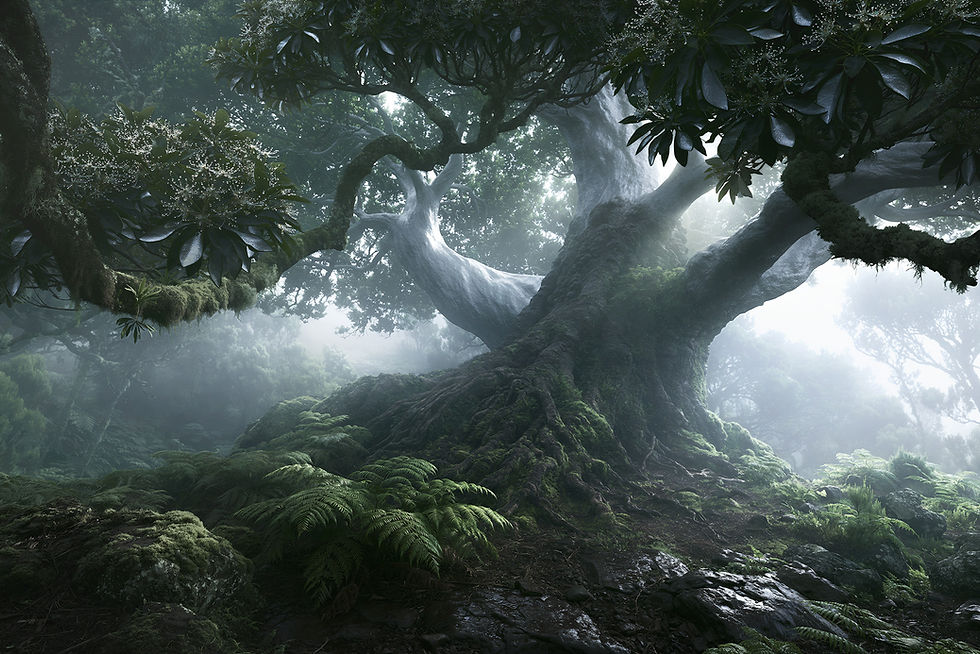
Madeira has been heavily impacted by tourism accelerated by social media exposure. Seeing protective fences built around ancient trees broke something inside me.
If before I was convinced that locations should not be named, now I am one thousand percent certain.
When nature needs fences to protect itself from photographers, something has already gone terribly wrong.

Normalising damage: Iceland and the Dolomites
I have witnessed the same phenomenon in Iceland and in the Dolomites.
Places that were once fragile but accessible are now:
restricted
fenced
regulated
partially off-limits
Not because nature suddenly became weaker.But because human behaviour became worse.
This is not tourism. It is bad manners on an industrial scale.
A phenomenon so poorly managed that it actively prevents people from experiencing beauty at all.

Decontextualisation as resistance
In this context, removing geographic references is not romanticism. It is resistance.
It is an attempt to restore:
mystery
ambiguity
silence
An image does not need to tell you where it was taken. It needs to tell you how it felt.
If a photograph can be consumed without slowing down, without thinking, without asking questions, it has already failed.

Lofoten Islands — saturation, not wonder
I was there to guide a workshop, and the experience was — frankly — terrible.
Not because of the landscape.But because photography had already exhausted it.
Everywhere I went, I saw:
the same spots
the same compositions
the same expectations
It felt like walking inside an archive of images already made.
That trip marked a breaking point for me.
I made a conscious decision: I never published a single image from Lofoten.
Not as a statement. As an act of coherence.
Adding one more cliché to an already saturated visual space felt dishonest.
Competitions, profit, and the institutionalisation of cliché
There is another uncomfortable truth that must be addressed.
Many photographic competitions — especially those primarily driven by profit rather than artistic research — have played a decisive role in reinforcing this system.
Year after year, they reward the same images:
from the same overexploited locations
framed from the same iconic viewpoints
built on the same visual formulas
The podium rarely changes. Sometimes, neither do the names.
This is not a conspiracy. It is a business model. Competitions built on submission fees and visibility need recognisable images. They reward familiarity, not risk.
Some of the most celebrated photographers today are not explorers of vision, but representatives of photography as a commercial product.
Is this wrong? No.
Is it criticisable? Absolutely.
Because when repetition is rewarded, art stops evolving.
The illusion of access and the failure of management
This situation is not inevitable. It is the result of choices.
Places could be protected intelligently:
by limiting access
by educating visitors
by discouraging viral exploitation
by shifting focus away from iconic viewpoints
Instead, we rely on fences, bans and emergency measures.
We treat symptoms, never causes.
And the cause is simple:we turned places into products and photographers into marketers.
Choosing absence over noise
This is not a manifesto against travel. Nor against landscape photography.
It is a refusal of visual pollution.Of repetition without thought. Of beauty reduced to content.
Sometimes, the most ethical image is the one you decide not to share.
And sometimes, protecting a place starts by refusing to turn it into a destination.

Vision & Philosophy
This article opens a series of reflections on authorship, responsibility and meaning in contemporary visual culture.
Not solutions. But questions we can no longer avoid.


What a thoughtful piece of writing https://en.wikipedia.org/wiki/Digital_marketing I've bookmarked this page because I think it covers the subject really well. It is worth going through useful resource before settling on anything. Looking forward to reading more from this blog.
Questo titolo mi ha colpito subito, un po' come un pugno nello stomaco, ma in senso buono, stimolante. È vero che la fotografia di paesaggio, nella sua ricerca ossessiva della "foto perfetta", rischia di diventare predatoria. Mi vengono in mente quelle immagini di luoghi incontaminati, ripresi da angolazioni sempre più audaci, che poi diventano mete turistiche di massa, perdendo proprio quell'essenza che li rendeva unici. Ho visto succedere cose simili con i miei occhi: sentieri battuti da migliaia di persone dove prima c'era solo silenzio, l'invasione di droni che disturbano la fauna selvatica per ottenere prospettive "uniche". È una contraddizione affascinante e dolorosa allo stesso tempo. Forse dovremmo imparare a fotografare non solo per condividere la bellezza, ma anche per…
I agree with what you say.
In my area, there are also cases of very beautiful places that have had to be regulated due to the massive influx of people, and simply because they are so crowded, I don't feel like photographing them. I prefer to look for other alternatives that are just as beautiful but less well-known and less crowded. Usually small landscapes. I like to search for and explore new places and then photograph them.
In my opinion, photographs of the most iconic and photographed places become tiresome. At first, when you see them for the first time, they make an impact, but after a while you see that they are repeated over and over again and are…
I agree with all your statements and would love to have your ethical stance. I think that may be easier for established photographers who have already had those experiences of the type of place you mention. There's no doubt that establishing photographers do chase likes and often visit the iconic locations first before moving onto more meaningful personal work. It would be difficult to gain any traction for sharing images if they were only of the more personally meaningful type. of course, why should be chase likes, because it's a validation, without any other forum for establishing self confidence it can be small part of ensuring we have the confidence to move away from the norm?