Where Light Becomes Narrative

Shaping atmosphere from landscape to dark fantasy with Boris FX Optics
There is a moment in every image when reality stops being enough.
Not because the scene is lacking, but because what you felt standing there—the weight of the air, the silence, the tension between light and shadow—simply doesn’t translate. The camera records. It does not interpret.
That gap has always been the real subject of my work.
I never approached landscape photography as documentation. From the beginning, it was about atmosphere—about building an emotional space rather than describing a physical one. Over time, that same approach naturally expanded into darker territories, eventually leading to what I now define as Hybrid Visual Art through The Midnight Lodge.
But the foundation never changed.
It has always been about light.

The limitation of the “straight image”
A raw capture, even a technically perfect one, is often incomplete.
Depth collapses.Light flattens.Atmosphere disappears.
What remains is a record of a place—but not the experience of it.
“A photograph without interpretation is only half an image.”
This is where the process begins. Not as correction, but as construction.
Color as intention, not adjustment
One of the most misunderstood aspects of post-production is color.
Color is often treated as something to fix—white balance, contrast, saturation. But in reality, it is one of the most powerful narrative tools available.
With Boris FX, particularly in the way I approach color grading, the goal is not to enhance what is already there. It is to redirect the image.
Subtle shifts in tonal relationships can change the entire psychological reading of a scene. I tend to avoid aggressive complementary contrasts; they often feel artificial, decorative. Instead, I work with restrained, analogous palettes—letting tones blend into each other, shaping a cohesive atmosphere.
“Color is not correction. It is direction.”

In landscape work, this allows the scene to breathe in a more natural, yet more intentional way.In The Midnight Lodge, it becomes something else entirely—an instrument to build tension, unease, or quiet solemnity.
Same principle. Different outcome.
Depth is hierarchy
If color defines emotion, depth defines structure.
One of the most critical transitions in my workflow came with the ability to control depth not as a byproduct, but as a deliberate layer. This is where tools like Depth Mask ML become essential.
Using depth-based selections inside Boris FX allows me to separate the image into meaningful planes—not just foreground and background, but a full hierarchy of distance and importance.
This changes everything.
Atmospheric perspective can be sculpted.Light can be introduced gradually, instead of globally. Focus becomes narrative, not optical.
“Depth is not distance. It is hierarchy.”

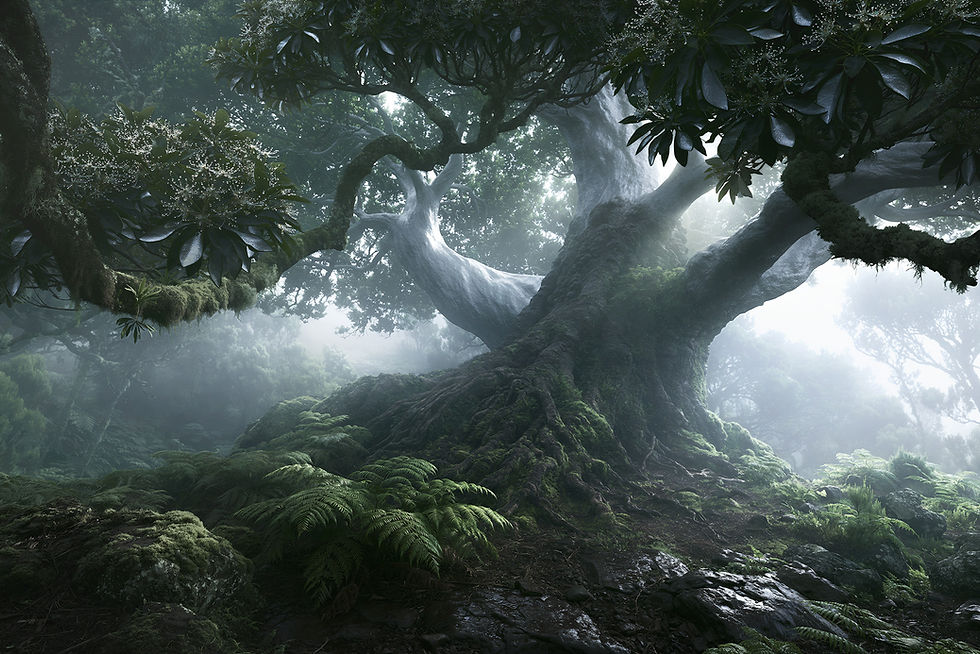
In a forest scene, it might mean guiding the eye through layers of fog and shadow. In a Midnight Lodge composition, it can define the presence of a figure, the weight of a structure, or the scale of an environment that doesn’t physically exist.
The tool is the same. The intention defines the result.
From landscape to The Midnight Lodge
People often see my work as divided into two paths: Romantic Landscape Photography and The Midnight Lodge.
In reality, there is no separation.
The Lodge is not a departure. It is a consequence.
Everything I learned working with real landscapes—light shaping, atmospheric layering, tonal control—became the foundation for building entirely new worlds. Not as an escape from photography, but as an extension of it.
“You don’t invent atmosphere. You learn how to recognize it—and then rebuild it.”
In this context, tools like Boris FX become essential not because they add effects, but because they allow control. Precision. Subtlety.
And subtlety is what separates an image that feels constructed from one that feels inevitable.
Hybrid Visual Art: control, not shortcut
There is often a misconception around workflows that combine photography, digital painting, and AI-assisted elements. The assumption is that they simplify the process.
In reality, they demand the opposite.
More decisions.More control.More responsibility over every single element in the frame.
Hybrid Visual Art, as I approach it, is not about generating images. It is about resolving them. Taking fragments—photographic, synthetic, imagined—and forcing them into coherence.
Light must be consistent.Depth must be believable.Atmosphere must hold together.
Without that, the image collapses.
Tools don’t solve this. They enable it.

Closing
At the end of the process, what matters is not the software, nor the technique.
It is whether the image holds.
Whether it feels like a place you could step into.Whether the silence inside it is real.
“Tools do not create vision. But without the right tools, vision remains incomplete.”
And sometimes, the difference between a captured image and a lived one is nothing more than how precisely you shape the light—and how deeply you understand the space behind it.


Great explanation and a shared perspective on digital editing