Descent to Rivendell — Breaking the Barrier

How a photograph made in 2014 became the foundation for a world that had existed in my imagination for much longer.
There are landscapes that we photograph, process and eventually leave behind.
Others remain with us.
They continue to change in memory, slowly separating themselves from the precise moment in which they were made. They become less connected to what stood physically in front of the camera and more closely connected to what we felt while looking at it.
This photograph belongs to the second kind.
I made it in 2014 at Sixt-Fer-à-Cheval, in the French Alps. A river crossed the floor of the valley and disappeared into an opening filled with mist and cold light. Above me, a massive rock overhang created a dark natural frame, almost like the entrance to a hidden world.
Everything in the original photograph was real.
The journey, the weather, the valley, the river, the light and the decision to stand precisely there with my camera were all part of an experience that could never be generated or repeated by a machine.
And yet, even then, I felt that the photograph contained something more than what was physically visible.
It felt like a threshold.

Sixt-Fer-à-Cheval, French Alps, 2014. The real landscape from which the entire project developed.
The structure of the image already suggested a journey.
The dark rock formed a gateway. The river became a leading line, pulling the eye deeper into the valley. The fog concealed the end of the path, while the light beyond it created the feeling that something was waiting behind the visible landscape.
At the time, I interpreted the photograph through the tools and knowledge available to me. Light, atmosphere, tonal structure and color allowed me to move the image closer to what I had experienced emotionally.
But the deeper vision remained unresolved.
I could feel it, but I could not yet give it a convincing form.
The worlds that stay with us
I was around sixteen when the writings of J.R.R. Tolkien and the artwork of John Howe entered my imagination.
At that age, everything still appeared capable of containing another world.
A forest was never only a group of trees. A mountain could hide a forgotten city. A path disappearing into the fog could lead somewhere that did not exist on any map.
The illustrations of John Howe had a particularly lasting influence on me. They did not simply depict fantasy settings. They gave nature a narrative presence. Mountains, ruins, architecture and small human figures all became parts of a much larger journey.
Decades later, that influence still shapes the way I read a landscape.
Not because I want to reproduce his imagery or create an imitation of Rivendell, but because his work taught me to recognize the possibility of myth inside a real place.
The most meaningful influences are not those we copy.
They are those that eventually become part of the way we see.
My sincere thanks to John Howe for the worlds he opened to me as a teenager, and for an inspiration that continues to accompany my work today.
The vision came before the technology
Artificial intelligence did not invent the idea behind this image.
The technology arrived much later.
The desire to place an ancient settlement inside the valley, to transform the river into the path toward a hidden refuge and to introduce small travelers moving through the landscape had existed in an undefined form since I first processed the photograph.
What changed was my ability to explore that vision.
Twelve years after making the original image, I returned to it with a new collection of tools and a very different level of creative freedom.
The purpose was not to cover the photograph with fantasy elements.
It was to discover whether the world I had imagined could be integrated into the reality I had actually experienced.
Photography as a threshold
One of the most repeated criticisms of generative imagery is that it removes the experience from photography.
I believe this confuses the final appearance of an image with the process that gave it meaning.
Photography is not only the file produced by the camera.
It is the journey, the search, the weather, the waiting, the physical presence of the photographer and the countless decisions made before the shutter is released.
AI did not travel to Sixt-Fer-à-Cheval in my place.
It did not stand beneath the rock, observe the movement of the fog or recognize the potential of that composition. It did not establish the emotional relationship that has kept me connected to this photograph since 2014.
The photograph remained the foundation.
Its geography, perspective, light and atmosphere established the rules that every new element would eventually have to respect.
Without that foundation, the result might still have been an attractive fantasy landscape, but it would not have belonged to my story.
Breaking the barrier
For many photographers, an invisible barrier still separates acceptable interpretation from unacceptable transformation.
Light can be adjusted. Contrast can be shaped. Color can be changed. Atmosphere can be intensified.
But when the physical reality of the scene is altered, the work suddenly becomes uncomfortable to categorize.
My objective has never been photography as a purely documentary act.
I have always been interested in going beyond the surface of the visible world: using a real place to evoke memory, emotion, mystery and narrative.
The camera gives me the threshold.
The creative process allows me to cross it.
This is why I have begun describing this approach as Extended Reality Photography.
It is not an attempt to disguise generated imagery as an untouched photograph. It is a hybrid practice in which field photography, traditional processing, generative exploration and manual compositing become parts of the same artistic process.
Reality is the origin.
It is no longer necessarily the limit.
Reading the landscape

Before generating anything, I returned to the original composition and identified the elements that could not be lost.
The upper rock overhang had to remain the dominant natural frame.
The river had to preserve its role as the line guiding the viewer into the scene.
The central opening of light had to remain mysterious and unresolved.
The scale and character of the valley had to survive every transformation.
Only then could I begin to consider where the imagined architecture might exist, how a path could be introduced and where human figures could create scale without becoming the central subject.
The landscape was not an empty background waiting to be decorated.
It was the structure governing every decision.
From visual memory to concept

The first explorations were created with GPT Images.
I used it primarily as a concept-development tool: a way to test relationships between the valley, architecture, travelers and atmosphere without expecting a finished result.
Some versions were visually impressive but moved too far away from the original photograph. Others placed the architecture in areas that weakened the composition or changed the scale of the valley.
The strongest concepts became references for further exploration in Midjourney.
At this stage, the architecture began to acquire a clearer identity: pale stone, vertical Gothic-Elvish forms, terraces, bridges and structures emerging from the cliff rather than merely sitting on top of it.
The phrase Gothic-Elvish architecture proved particularly effective in describing the balance I wanted: elegant but ancient, refined but monumental, fantastic without becoming decorative or cartoonish.
Generating is not creating the final image

Generative tools can produce an enormous number of possibilities in a very short time.
That does not mean every possibility is useful.
Many of the early versions failed.
Some castles were too large and overwhelmed the valley. Others appeared detached from the mountain. In several images, the original geography disappeared completely beneath a generic fantasy landscape.
Some were beautiful in isolation but wrong for this photograph.
This is where selection becomes part of authorship.
The most spectacular result is not necessarily the right result.
The correct element is the one that supports the original vision, respects the photograph and strengthens the story without drawing attention to the technology that produced it.
The architecture had to belong
The fortress was the most difficult element to resolve.
It needed to remain readable through the fog, but not appear artificially sharp. It needed sufficient scale to function as the destination of the journey, but it could not dominate the valley.
Most importantly, it had to feel as though it had always belonged to the mountain.
The bridge, waterfalls and layered structures helped connect the architecture vertically to the cliffs. Atmospheric haze softened the most distant surfaces, while parts of the original vegetation and rock were brought back across the generated material.
The fortress was not simply pasted into an empty space.
The mountain, mist, trees and water had to grow around it.
The anatomy of the blend

The generated elements were only raw material.
The final construction required a long compositing process in Photoshop involving masking, rebuilding, local tonal correction, atmospheric integration and repeated comparison with the original photograph.
Perspective had to be believable.
Light direction had to remain coherent.
Contrast and sharpness had to decrease with distance.
Fog had to move both in front of and behind the architecture.
Color temperature, texture density and reflected light all had to belong to the same environment.
The travelers and the path required the same attention. They were added to provide human scale and narrative direction, but they needed to remain secondary to the landscape.
Every element had to appear to share the same weather, the same light and the same physical space.
Craft still makes the difference
There is a belief that increasingly capable AI tools will make technical knowledge irrelevant.
My experience has been the opposite.
The more possibilities a tool provides, the more important judgment becomes.
You can generate the most beautiful castle in the world. If you blend it badly, it will remain an expensive sticker pasted onto a photograph.
A convincing result still requires knowledge of composition, perspective, light, color, masking, atmospheric depth, texture, local contrast and image finishing.
It also requires the ability to recognize when something is not working, even when it looks impressive.
Most viewers may not consciously identify an incorrect haze transition or an inconsistent scale. But they will feel that something is wrong.
The illusion will break.
AI does not eliminate craftsmanship.
It moves craftsmanship into new parts of the process and makes visual judgment more important than ever.
Taking control back
Another danger of generative tools is their endless ability to propose another variation.
Another castle.
Another mountain.
Another atmosphere.
Another interpretation of the same idea.
At some point, the artist has to stop generating.
A direction must be selected, the possibilities reduced and manual control restored. Otherwise, the process becomes an endless search for novelty rather than a deliberate construction of meaning.
AI can open doors and generate raw possibilities.
It cannot decide which story I am trying to tell.
That responsibility remains mine.
The original and the extended vision
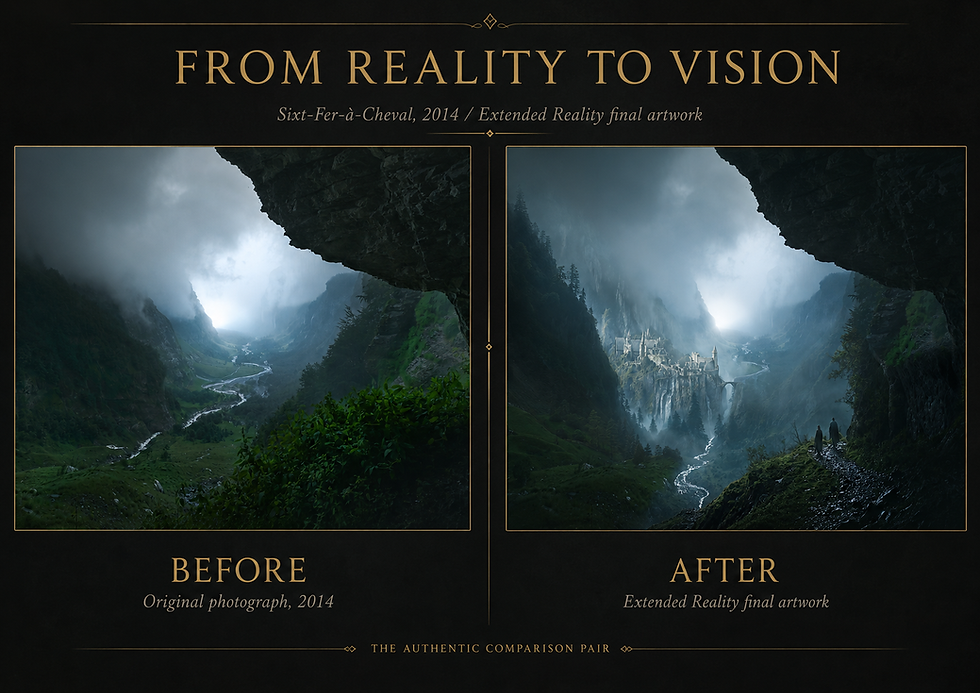
The original photograph and the Extended Reality version do not compete with each other.
One does not invalidate the other.
The first records the place I found.
The second reveals the world that the place awakened in my imagination.
Between them lie twelve years of experience, changing technologies and a visual language that has continued to evolve without losing its connection to the influences that shaped it.
The new image is not a correction of the old one.
It is its continuation.
Beyond the veil

I have never been interested in photography as a simple act of recording.
What fascinates me is the possibility of using a real landscape as the threshold to something deeper: an atmosphere, a memory, a story or a hidden world.
In that sense, AI does not replace photography for me.
It extends it.
The photograph remains the lived experience, the foundation and the truth of the place.
Beyond that truth, however, another image may exist—one that has lived in the imagination for years, waiting for the tools capable of bringing it into view.
I do not use artificial intelligence to avoid photographing the world.
I use it to reveal what the world made me imagine.
Photography is not the end of the process.
It is the threshold.
And sometimes, beyond that threshold, another world is waiting.


Ho trovato questo post estremamente stimolante. L'idea di "rompere la barriera" e la metafora della discesa verso Rivendell evocano un senso di avventura e scoperta che mi ha subito catturato. Spesso ci troviamo bloccati in schemi mentali, in routine che ci impediscono di progredire o di vedere le cose da una nuova prospettiva. La discesa verso un luogo di saggezza e bellezza come Rivendell, nella mia interpretazione, rappresenta proprio questo: un viaggio interiore verso una maggiore comprensione, un distacco dal rumore di fondo per ascoltare la nostra voce più profonda. Mi chiedo spesso quanto del nostro potenziale rimanga inespresso proprio a causa di queste barriere autoimposte. Abbiamo paura di ciò che si trova al di là del conosciuto, delle possibili…