The Lost Seed of Galathilion

A Tolkien-Inspired Visual Story in Madeira
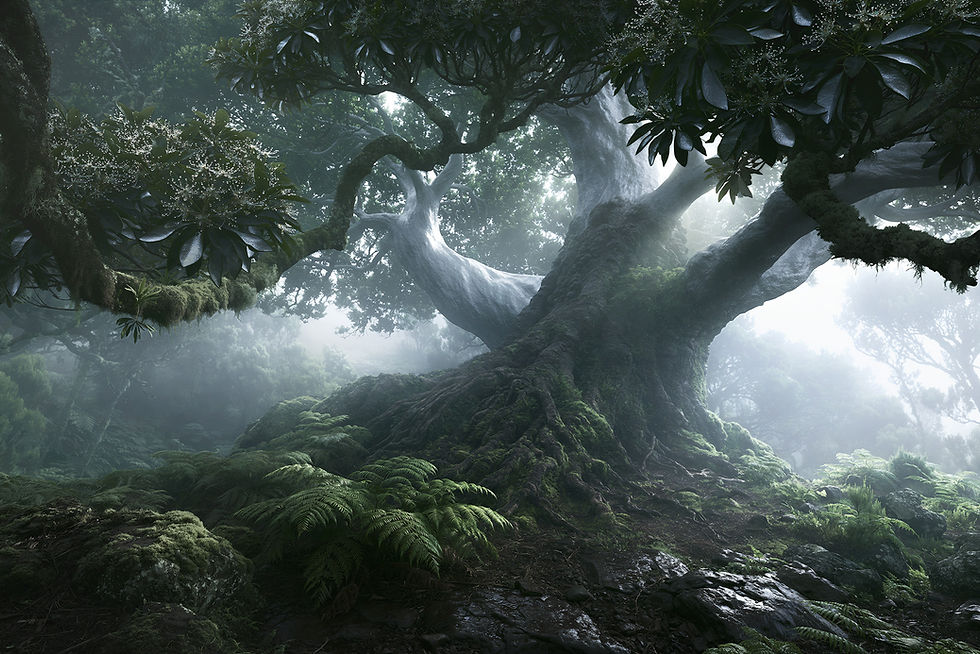
There are places that do not need to be invented.They only need to be listened to long enough.
Madeira was one of those places for me.
When I first photographed its laurel forests, I was not thinking about creating a fantasy project. I was responding to what was already there: the darkness under the canopy, the cold diffusion of light, the moisture suspended in the air, the wet volcanic stones, the roots crossing the ground like old veins, and the strange feeling that the forest was older than the path beneath my feet.
Some landscapes do not simply present themselves as scenery.They suggest a hidden continuity.
That feeling became the foundation for The Lost Seed of Galathilion, a Tolkien-inspired visual study built around landscape memory, botanical world-building and AI-assisted image-making.
This is not an official Tolkien production, nor an attempt to reproduce an existing visual adaptation. It is an independent artistic interpretation: a way of asking what might happen if a forgotten seed from an ancient myth had survived in secrecy, carried across ages, until it became part of a real forest.
Not placed there.Not pasted there.But slowly absorbed by the land.
From Myth to Landscape
The idea began with Galathilion, the White Tree created in Tolkien’s mythology as an image of beauty, lineage and sacred memory. But I did not want to treat it as a clean fantasy emblem or a decorative glowing tree standing in the middle of a forest.
That would have been too easy, and probably too false.
I wanted to imagine it as a living survivor.
A tree that had endured rain, darkness, wind and time. A tree whose white-silver bark would still be visible, but no longer immaculate. Its trunk would be scarred, partially reclaimed by moss, anchored in volcanic ground and surrounded by the dense ecology of Madeira’s laurisilva.
The fantasy element had to become physically believable.
For me, this is where the project became interesting. The challenge was not only to create a beautiful image. The challenge was to translate myth into a credible natural subject.
The white bark could not look like polished marble.The silver leaves could not become metallic decoration.The blossoms had to remain delicate, almost botanical.The silver dew had to feel connected to real moisture, rain and condensation.
The more mythic the subject, the more important it became to ground it in something real.
Madeira as Visual Memory
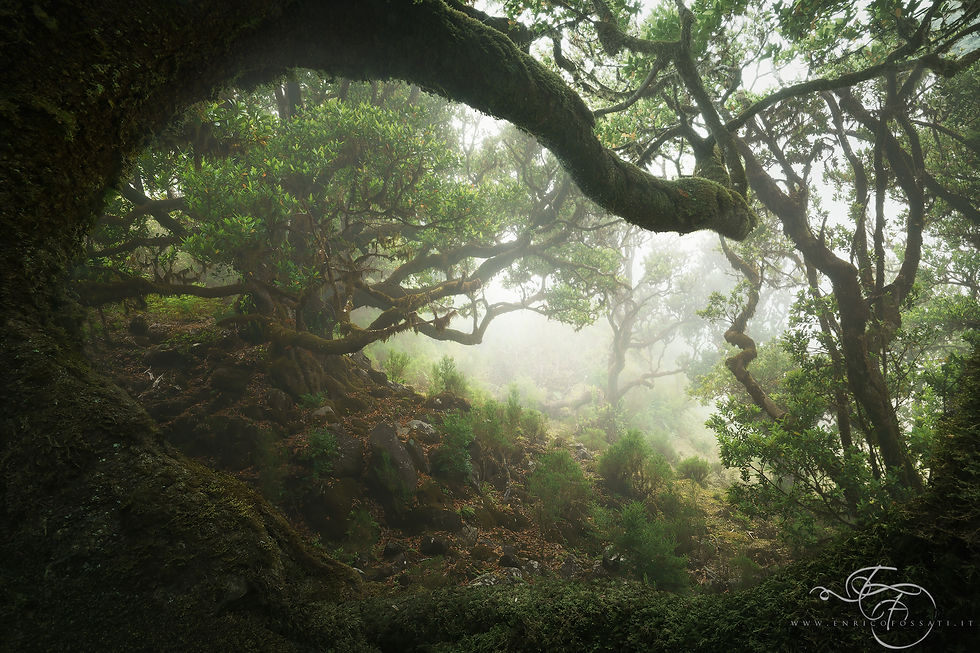
The forest is not a backdrop in this project. It is the visual grammar.
My experience in Madeira shaped every decision: the density of the vegetation, the muted light, the humidity, the dark stone, the exposed roots, the wet foliage and the way fog seems to remain trapped between trees.
Without that memory, Galathilion would risk becoming a generic fantasy object. Within the laurisilva, however, it can appear as something that has always belonged there.
That distinction matters to me.
I am not interested in using AI to escape photography. I am interested in using it to extend what photography made me imagine in the first place.
The photographic experience remains the origin: being there, walking through the forest, observing how light behaves, remembering the atmosphere, understanding the physical weight of the place. AI enters later, as part of a broader process of visual development, selection, rejection, compositing and final interpretation.
The real place gives the invented subject its authority.
A Sequence, Not a Single Image

The project was designed as a sequence of discoveries rather than as one isolated fantasy illustration.
The first encounter should not explain everything immediately. The forest must come first. The viewer should feel the density of the place before understanding what is hidden inside it.
Then, gradually, the subject begins to reveal itself.
A pale shape behind the fog.A monumental trunk emerging from shadow.Roots gripping the dark earth.Leaves catching backlight and revealing a silver underside.Clusters of white blossoms.Drops of luminous moisture suspended like a secret language of the forest.
The movement is from landscape scale toward botanical intimacy.
That progression is important because it gives the work rhythm. It prevents the image from becoming only spectacle. The tree is not introduced as an object to be admired immediately, but as a presence to be discovered.
The viewer enters the forest first.Only later does the myth appear.
Extended Reality Photography

I have started calling this approach Extended Reality Photography.
It is not documentary photography, because the final image moves beyond what was physically present in front of the camera.
It is not pure AI generation either, because the project is rooted in real places, real photographic memory, visual culture, post-production experience and authorial direction.
For me, Extended Reality Photography describes a hybrid process where reality remains the foundation, but no longer the limit.
A place is photographed, remembered, interpreted and then expanded. Generative tools become part of the development process, but they do not replace judgment. They create possibilities. The artist still has to choose, reject, direct, integrate and finish.
That is where authorship lives.
Not in pretending the tool does not exist.Not in letting the tool decide everything.But in shaping the final world until all the parts belong to the same visual truth.
Generation Is Only the Beginning
One of the biggest misunderstandings around AI-assisted imagery is the idea that the image is finished the moment it is generated.
In reality, that is usually only the beginning.
It is now easy to create impressive fragments: a dramatic tree, a beautiful forest, a mysterious atmosphere. But fragments are not the same as a resolved artwork.
Light has to make sense.Scale has to hold.Textures cannot turn plastic.Fog must pass naturally through the space.The subject must not look like an expensive sticker placed over a landscape.
With Galathilion, the main problem was restraint.
A White Tree can easily become too ornamental, too clean, too magical in the wrong way. The more spectacular it becomes, the less believable it feels. The real work was often removing excess: reducing glow, aging surfaces, breaking symmetry, grounding the roots, darkening the environment, and making the tree feel less like an icon and more like an ancient organism.
The goal was not to create a fantasy tree.
The goal was to create the memory of one.
Why This Project Matters to Me

The Lost Seed of Galathilion is part of a wider direction in my work.
For many years I have used photography not only to document landscapes, but to interpret them through mood, atmosphere, light, color and emotional tension. My Dark Processing approach was already a way of pushing the image beyond literal representation while remaining connected to the experience of the place.
The new tools simply allow that process to expand further.
They make it possible to explore what a location suggested emotionally or narratively, even when that vision could not be fully expressed through traditional photography alone.
This does not make the original experience less important. It makes it more important.
Because without the experience, the image has no roots.
And in a project like Galathilion, roots are everything.
The Lost Seed
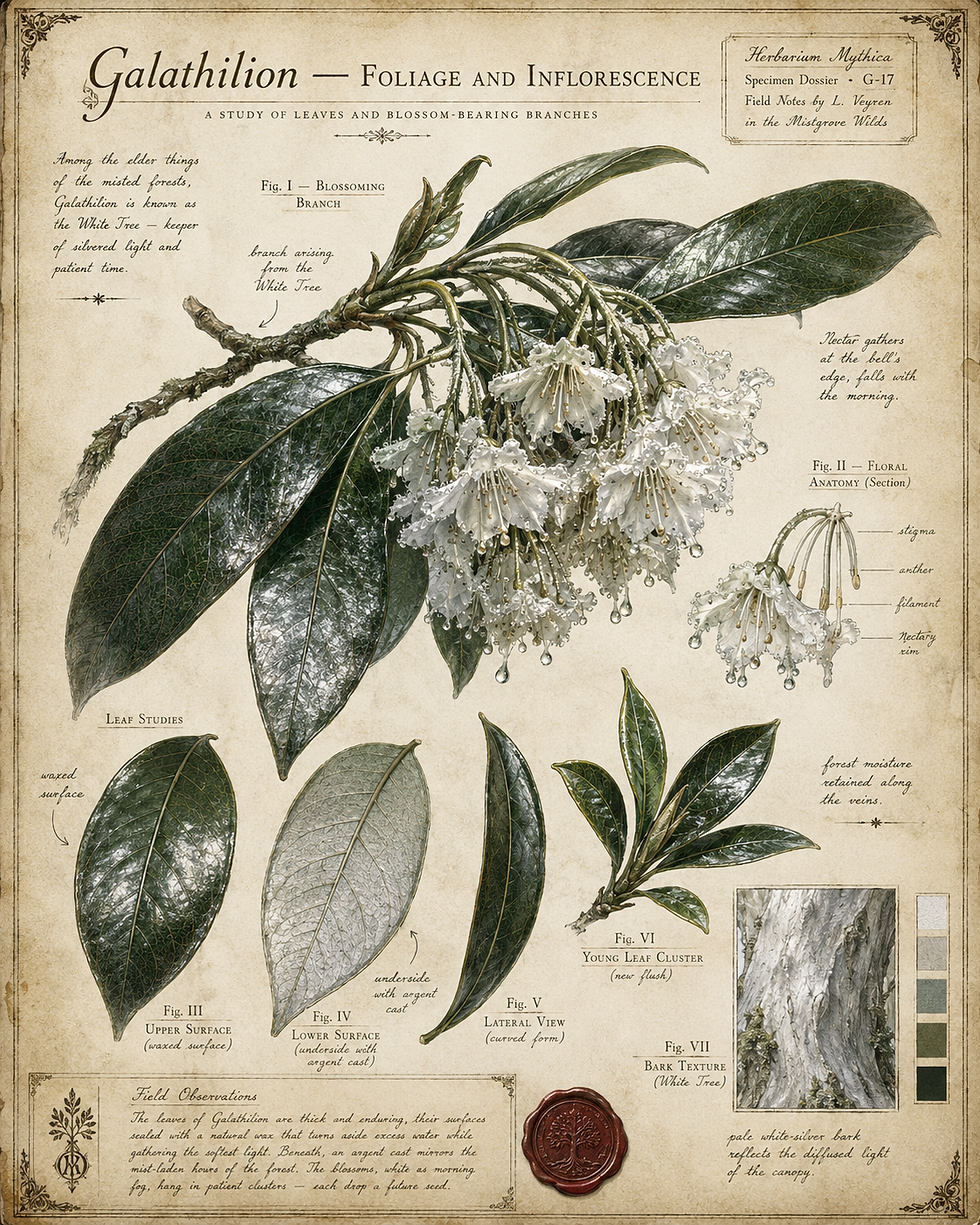
What interests me most about this project is the idea of survival.
A seed carried through forgotten ages.A myth hidden inside a real forest.A sacred tree no longer preserved in a shining court, but transformed by rain, moss, darkness and time.
There is something beautiful in that loss of perfection.
Galathilion, as I imagine it here, is not untouched. It has survived by becoming part of the world around it. Its sacred quality does not come from being separated from nature, but from being absorbed into it.
That is why Madeira felt right.
The laurisilva already has the atmosphere of an ancient memory. It does not need to be forced into fantasy. It already contains silence, age, moisture, darkness and mystery.
The project simply follows that suggestion further.
Photography is the threshold.The forest is the language.The myth begins where the mist refuses to explain everything.
Disclaimer
Independent fan-inspired visual study. Not an official Tolkien production and not affiliated with or endorsed by the Tolkien Estate, Middle-earth Enterprises or any rights holders.


Comments