The Work Beneath the Silence

On stress, creative exhaustion, and the hidden life of ideas during periods of apparent inactivity
There are periods when creativity does not disappear, but becomes inaccessible.
The ideas may still exist somewhere beneath the surface, yet the distance between imagining something and bringing it into existence feels impossibly wide. You open an unfinished photograph, look at it for a few minutes and close it again. You collect references without knowing what to do with them. You begin something, abandon it, return several days later and discover that whatever initially attracted you has already vanished.
Nothing seems entirely wrong, but nothing feels alive either.
For an artist, this kind of silence can be difficult to accept. We are accustomed to interpreting inactivity as failure: a loss of discipline, enthusiasm or talent. The longer it continues, the more threatening it becomes. We begin to wonder whether the creative impulse that once seemed inexhaustible has finally run out.
But creative work needs more than time.
It needs an inner territory that has not already been occupied by urgency.

When life consumes the available space
During periods of prolonged stress, even free time does not necessarily feel free. The body may be sitting still, but the mind remains engaged in unfinished conversations, practical decisions, possible dangers and imagined consequences.
A single problem rarely stays confined to the moment in which it occurs. It follows us into the evening. It enters the room while we are trying to work. It appears between one decision and the next, quietly consuming the attention that creative work requires.
This is particularly true when uncertainty lasts for months. The nervous system begins to treat every day as something that must be managed rather than inhabited. Energy is redirected toward immediate needs: finding solutions, anticipating difficulties, maintaining control.
Under these conditions, creativity can start to feel almost irresponsible.
How can we spend hours shaping light, rebuilding atmosphere or searching for the precise emotional balance of an image when part of the mind is still waiting for the next alarm?
The problem is not always a lack of ideas. Sometimes the ideas are present, but the space required to listen to them is gone.
The pressure to remain visible
Contemporary creative culture leaves little room for these periods.
Artists are expected to publish continuously, maintain an audience, answer messages, document their process and transform every experience into content. Silence is easily interpreted as disappearance. A few weeks without producing something new can feel like falling behind.
This creates a second form of pressure on top of the first.
We are no longer only dealing with the circumstances that interrupted our creativity. We are also judging ourselves for having been interrupted.
The result is often work produced to prove that we are still working. Images are finished before they have found their meaning. Ideas are forced into forms they are not ready to inhabit. Productivity becomes a substitute for direction.
But the number of things we complete says very little about whether we are truly creating.
Some periods are not meant for production. They are periods of endurance, observation and accumulation. They may be frustrating and apparently empty, but they are not necessarily sterile.
The hidden life of an idea
A landscape changes even when we cannot see it changing.
Beneath winter soil, roots continue to move. Water alters stone. Seeds remain dormant until temperature and light make growth possible again. What appears inactive may simply be working at a scale or rhythm that escapes immediate perception.
The creative mind can behave in a similar way.
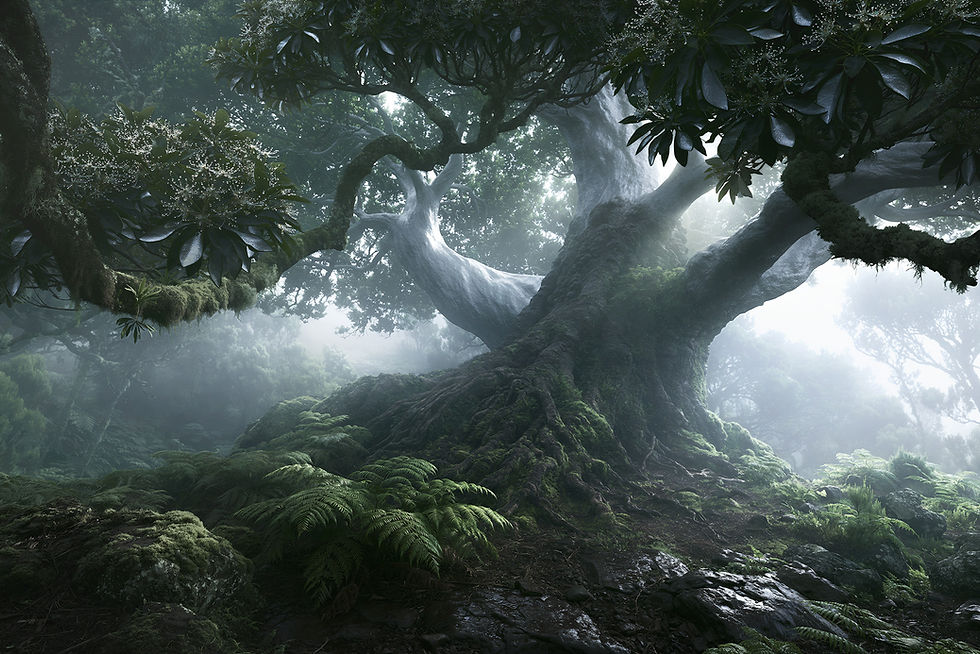
During periods in which I produced very little, I continued to absorb things: the shape of ruined architecture, the movement of mist through trees, fragments of writing, colours seen from a car window, memories of places I had not visited for years.
I was not consciously building an image from them. There was no project and no defined objective. They simply accumulated.
At the time, this accumulation felt useless. Only later did I realise that some of the images that emerged after those periods had already begun forming inside them.
This does not mean that suffering automatically produces valuable art. Pain is not a creative method, and exhaustion is not a source of moral or artistic superiority. Some difficult experiences leave nothing behind except the need to recover from them.
But creative sensitivity does not always stop when production stops.
It may retreat. It may become quieter. It may continue arranging fragments in a place we cannot yet access.

The danger of forcing the return
When the pressure begins to lift, there is often a temptation to compensate for lost time.
We expect inspiration to return dramatically. We want the first new work to justify the silence that preceded it. It must be important, complete and somehow capable of containing everything we have lived through.
That expectation can become another obstacle.
The first step back into creative work does not need to produce a masterpiece. It does not even need to produce a finished image.
It may begin with opening an old file and changing nothing. With studying a photograph that still contains an unresolved possibility. With testing a texture, a piece of architecture or a different quality of light. With collecting visual fragments without knowing whether they will ever belong together.
The first image after a difficult period does not need to be important.
It only needs to reopen the door.
There is something liberating in working without demanding immediate meaning. We can begin from curiosity instead of obligation. We can make incomplete things, discard them and return the following day without treating every failed attempt as evidence that the creative impulse has disappeared.
The return is rarely a sudden revelation. More often, it is a gradual restoration of trust.
Creativity is not a machine
For many years, I believed that consistency meant continuing regardless of circumstances. Discipline was the capacity to keep moving, to remain productive and to resist interruption.
There is truth in that idea. Creative work requires persistence. Waiting passively for inspiration is rarely enough.
But persistence is not the same as permanent output.
A machine can be expected to repeat the same operation every day. A human imagination cannot. It responds to experience, fatigue, fear, desire and change. Its rhythm is not separate from the life in which it exists.
There are moments when discipline means working.
There are others when discipline means refusing to turn creativity into one more source of punishment.
The difficult part is learning to distinguish avoidance from genuine exhaustion. Sometimes we are afraid to begin. Sometimes we truly have nothing left to give. The two conditions can feel similar, but they require different responses.
Fear may need a small act of courage.
Exhaustion needs recovery.
After the noise

When a long period of pressure finally ends, relief is not always immediate. The body may remain tense even after the danger has passed. Fatigue can become more visible precisely when we are finally allowed to stop.
Creativity may return in the same delayed way.
At first, there may only be silence. Then a fragment. A shape. A particular atmosphere that remains in the mind longer than the others. Slowly, the desire to build something becomes stronger than the obligation to do so.
Perhaps that is enough.
We do not always need to know exactly where the road leads. We only need to recognise the moment in which standing still is no longer protecting us.
The fog does not disappear all at once. The ruins do not suddenly become less intricate. There is no certainty waiting beyond them.
There is simply a point at which another step becomes possible.
And sometimes creativity returns exactly like that: not as inspiration descending from somewhere above, but as the quiet willingness to move again.


Comments