When Landscape Photography Made Us Dream

On vision, influence, and the distortion of the creative process

There was a time when I could see a landscape photograph once and remember it for years.
Not because it was technically perfect. Not because it depicted a famous location, collected thousands of reactions, or followed an immediately recognizable formula. I remembered it because it seemed to contain a world. It carried the unmistakable presence of the person who had made it: their obsessions, their visual culture, their relationship with nature, and their willingness to push an image beyond the expected.
During what I now think of as a particularly fertile period in contemporary landscape photography, the work of photographers such as Marc Adamus, Alex Noriega, Erin Babnik, Ryan Dyar, and Ted Gore repeatedly produced that effect. Beyond the conventional borders of the genre, the imagined landscapes of Michał Karcz showed how photography could become the raw material for entirely new realities. These artists were very different from one another, but their strongest images shared a quality that has become increasingly difficult to find: they were memorable.
This is not an attempt to establish a ranking, nor is it a claim that meaningful photography no longer exists. Exceptional work is still being made, and every period tends to romanticize the one that formed it. I am also aware that I have changed. After many years of making, teaching, and looking at images, surprise naturally becomes more elusive.
Yet I do not believe that personal nostalgia explains everything. Something deeper has changed in the way photographs are conceived, circulated, and judged. We have moved from creating images in the hope that they might remain in someone’s mind to creating images designed to earn an immediate response. The difference may appear subtle, but it reverses the entire creative process.
When Processing Became a Language
Marc Adamus was the first photographer who made me understand the expressive power of post-production. His work arrived with an intensity that was difficult to ignore: dramatic light, enormous depth, ambitious compositions, and a sense that the landscape was not merely being recorded but experienced at full emotional volume.
What mattered, however, was never processing alone. Adamus possessed a rare compositional ability and an equally rare connection with wilderness. His photographs were supported by genuine immersion in remote landscapes, by physical commitment, patience, and a willingness to encounter nature on its own terms. The digital darkroom amplified that experience; it did not replace it.
That distinction is essential. Post-production was never the enemy of landscape photography. Used with intention, it gave photographers a larger vocabulary. It allowed them to organize light, color, atmosphere, and visual hierarchy in ways that came closer to memory and emotion than to the mechanical neutrality of a camera file. Adamus helped an entire generation understand that a raw capture was not necessarily the conclusion of the photographic act. It could be the beginning.
His influence was therefore larger than a particular aesthetic. He demonstrated that an image could be boldly interpreted while remaining rooted in a profound encounter with the natural world. The spectacle in his photographs was earned in the field and shaped in post-production. That combination made the work powerful.
Alex Noriega later changed my photography in a more direct and personal way. He was my teacher, and the person who truly unlocked post-production for me. He gave me tools and ways of thinking that became the foundations on which I eventually built my own workflow.
My admiration for him has always been enormous, and I still consider him one of the finest landscape photographers of his generation. His importance does not rest on technical expertise alone. Alex has always understood restraint, mystery, atmosphere, and the intelligence of exclusion. His strongest photographs do not attempt to overwhelm the viewer with information. They isolate what matters.
That combination of control and imagination is visible throughout his work, from intimate forest scenes to desert abstractions and grander landscapes. Images such as Dream of Rain, Spirit of the Merced, and Phendrana Drifts reveal a photographer interested not in objective description but in suggestion. The compositions are readable yet mysterious, refined without becoming sterile. They invite the imagination to complete what the frame withholds.
What I learned from Alex was not how to reproduce his results. The real gift of a great teacher is not a collection of recipes but a foundation that allows another person to become independent. The methods he taught me became the base from which I could construct something personal: my own relationship with darkness, atmosphere, painterly light, and the imagined worlds that gradually entered my work. In that sense, his influence is embedded in my photography even where our images look completely different.
Growth Through Criticism, Culture, and Trust

My relationship with Erin Babnik belongs to another important part of that period. Together with Alex, we were members of a small online critique group. It was a serious environment in which photographs were discussed with honesty and attention. The purpose was not mutual reassurance. It was growth.
That distinction now feels almost radical. Serious criticism requires trust, humility, and the willingness to let an image remain unresolved for a while. It asks the photographer to separate personal worth from the success or failure of a particular photograph. That group created the conditions for this kind of exchange, and everyone involved grew substantially through it.
It was also where the first seed of a professional partnership appeared, one that eventually brought Erin and me to work together in the Alps, organizing international tours with a strong educational value. It was an honor to work beside her. Very few people I have met combine such photographic ability with such deep artistic and historical knowledge. Even fewer combine those qualities with genuine fairness, reliability, and professional integrity.
Erin’s background in art history is not an ornamental credential attached to her photography. It shapes the way she sees, analyzes, and teaches. Her images are often adventurous and visually dynamic, but they are also structurally intelligent. They emerge from an understanding that composition is not a set of convenient rules. It is a way of creating relationships, tensions, rhythms, and meaning inside a frame.
That intelligence is clearly visible in photographs such as Tango Swoop, Grand Solitude, The Visitor, Geodescent, and Whirlwind. Across very different kinds of landscape, Erin repeatedly finds gestures in nature: curves that answer one another, masses held in tension, layers that establish rhythm, and small visual incidents that transform scale. The titles themselves often suggest movement, encounter, or relationship, and the photographs justify those associations through their structure rather than through explanation.

In Down to Earth, for example, a low shelf of cloud presses against the Eastern Sierra, reducing a vast mountain landscape to a restrained sequence of layers. The photograph does not depend on a conventional burst of sunrise or sunset color. Its power comes from the surreal relationship between sky and land, from the subtle balance of the elements, and from knowing exactly how much information the frame needs. Tango Swoop is more energetic, while Grand Solitude draws strength from scale and isolation; together they demonstrate the range of a photographer who can move between visual exuberance and quiet control without losing her identity.
This is what separates her photographs from images that are merely made in impressive places. Erin does not treat a location as the finished subject. She searches for the visual relationships that turn a place into a composition and an experience into a personal statement. Her adventurous approach in the field therefore matters not as biography or branding, but because it provides the raw conditions from which those relationships can be discovered.
Working with her also confirmed something that photographs alone cannot reveal completely: artistic seriousness and professional generosity can coexist. In a field where identity, ego, and business are often uncomfortably entangled, Erin has always represented to me a rare standard of competence and correctness. My respect for her work is inseparable from my respect for the person and colleague I came to know.
The existence of a group like that also illustrates what has been lost from much of today’s online photographic culture. Critique has gradually been replaced by affirmation. A heart, a fire emoji, or a short expression of amazement creates activity, but it rarely creates development. When every image is declared wonderful, the word loses all meaning. Growth requires friction, and a culture built around continuous approval removes it.

Images With a Signature
Ryan Dyar and Ted Gore were also central figures in that creative landscape. Their photographs demonstrated how far an author could push interpretation while preserving a recognizable relationship with the natural world.
Dyar’s best images possess an immediate sense of authorship. His use of atmosphere, glow, scale, and spatial separation can turn a mountain landscape into something that feels both physically present and psychologically enlarged. His acknowledged interest in nineteenth-century painters such as Albert Bierstadt is meaningful here, because it points to an influence outside the self-referential loop of contemporary photography. The goal was not simply to imitate another successful photograph. It was to translate a broader visual tradition into a modern photographic language.
Images such as Fortress of Erosion and Applaud the Sky do not survive in memory merely because they are dramatic. Many dramatic images are instantly forgotten. They survive because their drama has structure. Light, atmosphere, scale, and composition are directed toward a coherent emotional result. Dyar’s work made no claim to be neutral documentation; its strength came from openly accepting the photograph as an expressive construction.
Ted Gore brought another kind of sophistication to the same period. His portfolio combined ambitious compositions with an unusually developed understanding of color and processing. Photographs such as Purple Poison, Abandoned, and Cinque showed how unconventional terrain, difficult conditions, and complex visual elements could be organized into images that felt deliberate rather than chaotic.
His work was seductive, but not simply decorative. Behind the visual impact was a strong awareness of color relationships, balance, depth, and the internal movement of the frame. Gore demonstrated that advanced processing was most effective when supported by design. Without composition, color, and intent, technical virtuosity is merely surface.
Adamus, Noriega, Babnik, Dyar, and Gore never produced identical work. That is precisely the point. Even where they shared techniques, locations, or the broad ambitions of modern landscape photography, each developed a distinct visual identity. You could recognize the author before reading the name.
Beyond the Recorded Landscape

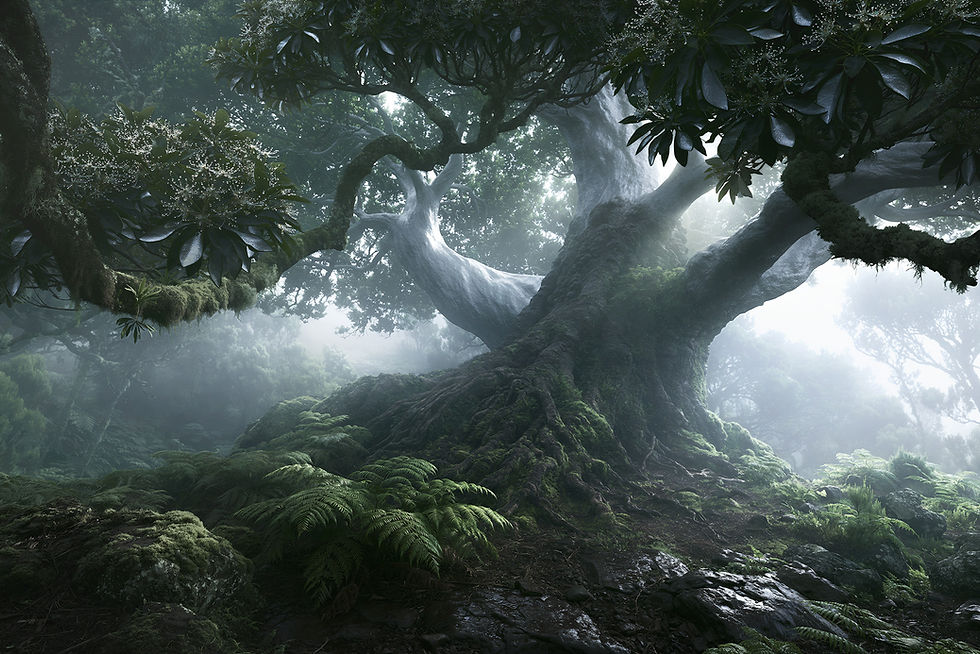
Michał Karcz extended that lesson beyond landscape photography in its traditional sense. I have never worked with him photographically, but his art has influenced me for many years. His creative ability is extraordinary. He uses photographic material not as a boundary but as a portal, combining remote landscapes, ruins, skies, storms, architecture, and atmosphere to construct parallel worlds.
His images did not encourage me to copy their appearance. They gave me permission to think more freely about what a photographic image could become. Long before hybrid imagery became a fashionable subject, Karcz showed that photographic credibility and imagination did not have to be enemies. A created world could feel emotionally true even when it had never existed in front of a camera.
During the NFT period, we had the opportunity to collaborate, and I was finally able to know something of the person behind those works. It was a genuine pleasure. I found him extraordinarily gracious: a person of rare kindness whose character matched the sensitivity and dedication visible in his art.
Karcz’s relationship with music is also fundamental to his work. His worlds frequently operate like visual soundscapes, and his long history of creating album artwork makes perfect sense. They do not merely illustrate a place. They establish a mood in which the viewer can remain. This ability to sustain atmosphere rather than deliver a single instant of visual impact is one reason his work has stayed with me for so long.
He represents an important bridge in my own development. My roots remain in landscape photography, but my interest has increasingly expanded toward hybrid imagery and extended reality: toward pictures in which captured nature, memory, digital construction, and imagination can coexist. Karcz helped demonstrate the artistic legitimacy of that territory.

The Reversal of the Creative Process
The photographers and artists I have discussed were not important because they discovered a secret collection of Photoshop techniques. They were important because technique served a vision. Their work was driven by curiosity, obsession, physical experience, visual culture, experimentation, and the desire to make an image they had not already seen a hundred times.
Today we have more technical knowledge than ever. Tutorials are everywhere. Cameras are astonishingly capable. Processing software can perform in seconds operations that once required years of experience. Artificial intelligence can generate spectacle almost without resistance. Yet this abundance has not automatically produced a corresponding abundance of memorable work.
Instead, much of contemporary image-making has become optimized for approval. The photographer learns which locations perform well, which colors attract attention, which kind of light produces an immediate reaction, which compositions are already familiar enough to be understood without effort, and which trends the platforms are currently rewarding. Before the image exists, its anticipated reception has already entered the creative process.
This is the distortion.
The problem is not that photographers want their work to be seen. Every artist hopes to reach an audience. The problem begins when the imagined response of that audience becomes the first creative decision. At that point, vision no longer leads and recognition follows. Recognition leads, and the image is engineered to obtain it.
Social platforms did not invent imitation, vanity, or fashion. The history of art contains all three. But platforms industrialized their feedback. They transformed approval into visible data and made comparison continuous. The result is an environment that rewards familiarity disguised as novelty: an image must look new enough to interrupt the scroll, but not so new that it demands patience or challenges expectation.
This pressure affects not only what is published but what is photographed, processed, and sometimes even imagined. We begin to internalize the audience. We crop for the screen, intensify for the thumbnail, repeat what performed well, avoid ambiguity, and discard quieter experiments before giving them time to mature. The algorithm does not need to command us directly. Eventually, we begin to anticipate it.
The consequence is a strange uniformity inside apparent abundance. We see an endless stream of spectacular mountains, glowing forests, turbulent skies, perfect reflections, tiny figures, and cinematic light. Many of these images are technically excellent. Some are genuinely beautiful. Yet they often dissolve into one another because they were built to satisfy the same expectations.
Memorable work usually contains some form of resistance. It may initially feel unusual, excessive, restrained, dark, complex, or difficult to categorize. It carries the risk of rejection because the artist has chosen something before knowing whether others will approve. If that risk disappears, authorship weakens with it.
What I Want From Photography Again
I do not want to return to an imaginary past. The tools available today are extraordinary, and I have no interest in defending artificial boundaries between photography, digital art, or hybrid creation. My own work continues to move across those borders. I believe the future of visual art will be richer because those distinctions are becoming more fluid.
But new tools do not remove the need for vision. They make it more urgent.
When almost anyone can produce a superficially impressive image, the artist’s responsibility is not to manufacture more spectacle. It is to decide why an image should exist. What does it reveal about the person who made it? What experience, knowledge, obsession, or imaginative necessity does it contain? Would it still matter without the metrics attached to it?
The artists who shaped me offered different answers. Adamus showed me the power of interpretation when it grows from wilderness and compositional strength. Noriega gave me the technical and conceptual foundations that allowed me to build my own language. Babnik showed me the value of culture, criticism, trust, and professional integrity. Dyar and Gore demonstrated how bold processing could remain personal when governed by emotion and design. Karcz opened a door into worlds where photography and imagination no longer needed to ask permission from one another.
Their strongest images remained in my mind because they were not created merely to please me. They existed first as the result of someone else’s vision. I was invited into that vision, not consulted in advance about how it should be made.
That is what I miss most, and what I still seek in my own work.
I want photographs that do more than stop my thumb for a second. I want images that establish a territory, that reveal an author, that continue working after the screen has gone dark. I want work that may divide opinion but cannot be mistaken for the output of a formula. I want artists to risk being misunderstood again.
Above all, I want to feel wonder again—not the brief stimulation of spectacle, but the slower and more enduring sensation of encountering an image that could only have been made by one particular person.
That kind of photograph does not ask the audience what it wants to see.
It shows us something we did not yet know we wanted to remember.


Comments